

Views: 0 Author: Site Editor Publish Time: 2026-04-13 Origin: Site


A fender can have enough width and still let the hull scrape the dock if the body is too short for the actual contact area. That is why boat fenders should never be judged by diameter alone. Length matters because docking pressure often spreads across part of the hull instead of one exact point. For owners who already understand the basics of boat protection, the more useful question is not simply whether the fender is big enough, but whether it is long enough to cover the way the boat really meets the dock. As a long-term marine protection supplier, Hongruntong helps customers match fender dimensions to real berthing conditions rather than appearance alone.
Many people assume that once the diameter looks right, the fender will do its job. In practice, that is only half the answer. A boat rarely presses against the dock at one perfect point. More often, the load spreads along a section of the hull as the boat moves with wake, current, or line tension.
That is where fender length starts to matter. A short fender can cushion one area well but leave the upper or lower part of the contact zone exposed. If the boat shifts slightly, the protected point changes and the hull may still touch the dock or piling. This is especially common when the boat rests alongside a berth for longer periods instead of making only a brief landing.
Length also affects stability. A longer fender body tends to sit more naturally along the hull and is less likely to feel inadequate when the boat settles at a slightly different angle. In other words, the right length helps turn protection from a small cushion into a more reliable contact barrier.
Shorter fenders can work well when the boat has low freeboard and the likely contact area is relatively compact. Small leisure boats, low-profile fishing boats, and other lighter vessels often dock against protected marina structures where contact is limited and controlled.
In these situations, the hull side does not extend as far above the dock line, so the fender does not need as much vertical coverage to protect the working area. That makes a moderate body length practical and easier to handle. It also helps with storage and rigging, which matters for owners who move fenders on and off the rail frequently.
Still, shorter does not mean undersized. The goal is not to use the smallest possible fender, but to choose a body length that covers the real contact band without leaving weak spots at the edges.
As hull sides get taller, the need for more length usually increases. Higher topsides create a broader vertical zone where contact may happen, especially when the dock sits lower than the boat or when water level changes during the day. In these cases, a short fender may protect the middle of the contact area but leave the upper or lower section exposed.
Deeper slips and fixed berths can make this even more obvious. When the boat settles alongside the dock for extended periods, the pressure line is not always concentrated in one small place. Longer coverage helps protect that changing band more consistently.
For that reason, taller recreational boats, cruisers, and heavier hulls often benefit from longer fender bodies rather than relying on a compact shape that only protects a narrow strip.
Some docking situations involve only a brief approach and a quick line adjustment. Others involve the boat lying alongside the dock for hours or days. In that second case, the hull often runs parallel to the berth, and the contact area naturally becomes longer.
That is where longer boat fender length becomes especially valuable. The goal is not simply to absorb a bump but to protect a wider section of hull through repeated light pressure and movement. If the boat is likely to rest against the dock for longer periods, longer body coverage often works better than a shorter unit that leaves gaps between contact zones.
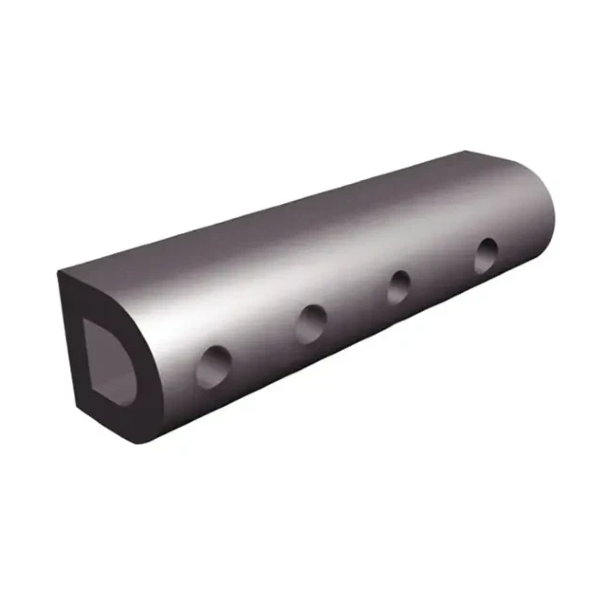
When a fender is hung vertically, body length becomes more visible and more important. Vertical placement works well when the likely contact zone stretches up and down rather than across a broader side area. In these setups, a longer body often gives better coverage because it protects more of the hull height in one piece.
Vertical hanging is especially useful where the dock edge sits lower than the boat or where the contact point changes slightly with tide, loading, or movement. The longer the useful contact band, the more likely it is that a longer vertically hung fender will perform better.
Horizontal hanging changes the job. Here, the fender is often being used to cover side contact over a broader section rather than a taller one. In this case, a shorter but well-proportioned fender may still work effectively, especially when the goal is to protect the beam area during ordinary marina docking.
This is why length should always be considered together with orientation. A fender that seems short in one hanging position may be practical in another. The best choice depends on how the boat actually approaches and rests against the berth.
Not every docking situation follows a clean side-to-dock pattern. Rafting, piling contact, narrow slips, and angled berthing all create uneven pressure. In those cases, fender length still matters, but it does not solve the whole problem by itself.
A longer fender may help cover more area, but awkward contact often also requires enough diameter and enough stand-off to keep the hull off narrow, hard points. This is where many users confuse “longer” with “better.” Sometimes a little more length helps. Other times the real need is a different shape or a stronger body.
Docking setup | Better length focus | Why it matters |
Side-to-dock mooring | Longer body coverage | Protects a wider contact band |
Pilings or posts | Balanced length and stand-off | Helps at narrow contact points |
Short-term marina docking | Moderate length | Easier handling and quick setup |
One of the most common mistakes is thinking that a long fender automatically provides better protection. It does not if the body is too slim for the load. A long but narrow fender may cover more area visually, yet still compress too easily when the boat leans into the dock.
That is why length should never replace proper diameter. A fender has to provide coverage and stand-off at the same time. If it is long but lacks enough body to absorb pressure, the result can still be poor protection.
For buyers comparing options, this is an important distinction. Boat fender length affects coverage. Diameter affects separation and impact absorption. Good protection depends on both.
Another common mistake is choosing length without thinking about dock geometry. A fender that seems long enough in one marina may suddenly feel too short when the dock is lower, the water level changes, or the boat sits differently under load.
Tidal movement, wake, and fixed dock heights all influence where the hull actually meets the berth. If those changes are ignored, the selected length may only protect part of the working area. That is why a fender should be chosen for the full docking environment, not for one still-water moment.
Sometimes the problem is not lack of length at all. If the boat is pressing too closely to the dock, or if the hull still makes contact under load, the real issue may be insufficient diameter. This is the most common misunderstanding in length-related searches.
A fender that is long enough but too narrow will not create enough stand-off distance. In that case, replacing it with an even longer slim fender does little to improve protection. The better fix is often to step up in diameter or move to a body shape that suits the contact pattern more effectively.
For projects with broader protection requirements, Hongruntong also supports customers with Marine Fenders solutions that go beyond standard portable use, especially where vessel size and berth demands become more complex.
If the same part of the hull keeps meeting the same part of the berth, changing portable fender length may not be enough. Repeated contact at slip entrances, quay walls, corners, and fixed posts often points to a dock-side issue rather than a boat-side issue alone.
That is where fixed protection becomes the more dependable answer. Instead of asking one portable fender to do all the work, the berth itself can be protected with a profile suited to repeated impact. Hongruntong’s dock protection range supports that step for customers who need more consistent protection in fixed contact areas.
So how long should a boat fender be? The best answer is simple: it should be long enough to cover the real contact area of the hull, not just long enough to look substantial. The right boat fender length depends on hull height, docking style, berth structure, and how the boat rests against the dock over time. When length and diameter are matched properly, protection becomes far more reliable. If you want help comparing options for your vessel or berth, contact us at Hongruntong for practical guidance on a better protection setup, from everyday onboard solutions to more specialized Dock Fenders for fixed contact zones.
Neither one should be treated as more important in every case. Length controls how much of the contact area is covered, while diameter controls separation and impact absorption. Good protection needs both.
If the hull still touches the dock above or below the protected area, or if the contact line extends beyond the fender body, the fender is likely too short for that docking setup.
In many cases, yes. Higher topsides often create a larger vertical contact zone, especially in deeper slips or at docks with changing water levels, so longer coverage becomes more useful.
Not always. If the same area keeps taking pressure, the better solution may be dock-side protection rather than simply increasing portable fender length.


